BFD for OSPF
This section describes the definition, the purpose and the principle of BFD for OSPF.
Definition
Bidirectional Forwarding Detection (BFD) is a mechanism to detect communication faults between forwarding engines.
To be specific, BFD detects connectivity of a data protocol on the same path between two systems. The path can be a physical link, a logical link, or a tunnel.
In BFD for OSPF, a BFD session is associated with OSPF. The BFD session fast detects a link fault and then notifies OSPF of the fault. This speeds up OSPF's response to the change of the network topology.
Purpose
The link fault or the topology change may cause routers to recalculate routes. Therefore, the convergence of routing protocols must be sped up to improve the network performance.
Link faults are unavoidable. Therefore, a feasible solution is required to detect faults faster and notify the faults to routing protocols immediately. If BFD is associated with routing protocols, once a link fault occurs, BFD can speed up the convergence of routing protocols.
| Associated with BFD or Not | Link Fault Detection Mechanism | Convergence Speed |
|---|---|---|
| Not associated with BFD | An OSPF Dead timer expires. By default, the timeout period of the timer is 40s. | At the second level |
| Associated with BFD | A BFD session goes Down. | At the millisecond level |
Principle
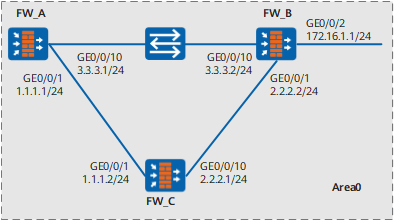
The principle of BFD for OSPF is as shown in Figure 1.
- OSPF neighbor relationships are established between these three Routers.
- After a neighbor relationship becomes Full, this triggers BFD to establish a BFD session.
- The outbound interface on FW_A connected to FW_B is GE0/0/10. If the link fails, BFD detects the fault and then notifies FW_A of the fault.
- FW_A processes the event that a neighbor relationship becomes Down and re-calculates routes. After calculation, the outbound interface is GE0/0/1 passes through FW_C and then reaches FW_B.