OSPF NSSA
Background
As defined in the Open Shortest Path First (OSPF) protocol, stub areas cannot import external routes. This mechanism prevents external routes from consuming the bandwidth and storage resources of routers in stub areas. If you need to both import external routes and prevent resource consumption caused by external routes, you can configure not-so-stubby areas (NSSAs).
Derived from stub areas, NSSAs resemble stub areas in many ways. Different from stub areas, NSSAs can import autonomous system (AS) external routes and advertise them within the entire AS, without learning external routes from other areas in the AS.
Related Concepts
N-bit
A router uses the N-bit carried in a Hello packet to identify the area type that it supports. The same area type must be configured for all routers in an area. If routers have different area types, they cannot establish OSPF neighbor relationships. Some vendors' devices do not comply with RFC 1587, and the N-bit is also set in OSPF Database Description (DD) packets. You can manually set the N-bit on a router to interwork with the vendors' devices.
Type 7 LSA
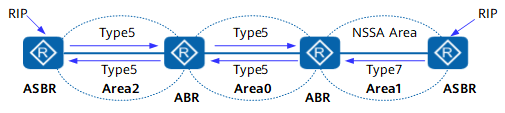
Type 7 LSAs, which describe imported external routes, are introduced to support NSSAs. Type 7 LSAs are generated by an autonomous system boundary router (ASBR) in an NSSA and advertised only within the NSSA. After an area border router (ABR) in an NSSA receives Type 7 LSAs, it selectively translates Type 7 LSAs into Type 5 LSAs to advertise external routes to other areas on an OSPF network.
Principles
To advertise external routes imported by an NSSA to other areas, a translator must translate Type 7 LSAs into Type 5 LSAs. Notes for an NSSA are as follows:
By default, the translator is the ABR with the largest router ID in the NSSA.
The propagate bit (P-bit) is used to notify a translator whether Type 7 LSAs need to be translated.
Only Type 7 LSAs with the P-bit set and a non-zero forwarding address (FA) can be translated into Type 5 LSAs. An FA indicates that packets to a destination address will be forwarded to the address specified by the FA.

FA indicates that the packet to a specific destination address is to be forwarded to the address specified by.
The loopback interface address in an area is preferentially selected as the FA. If no loopback interface exists, the address of the interface that is Up and has the largest logical index in the area is selected as the FA.
The P-bit is not set for default routes in Type 7 LSAs generated by an ABR.
Advantages
Multiple ABRs may be deployed in an NSSA. To prevent routing loops caused by default routes, ABRs do not calculate the default routes advertised by each other.