Association between OSPFv3 and BGP
When a new router is deployed in the network or a router is restarted, the network traffic may be lost during BGP convergence. This is because IGP convergence is quicker than BGP convergence. This problem can be solved through the association between OSPFv3 and BGP.
If a router on a BGP network recovers from a fault, BGP convergence is performed again and certain packets may be lost during the convergence.
As shown in Figure 1, traffic from RouterA to RouterD traverses a BGP network.
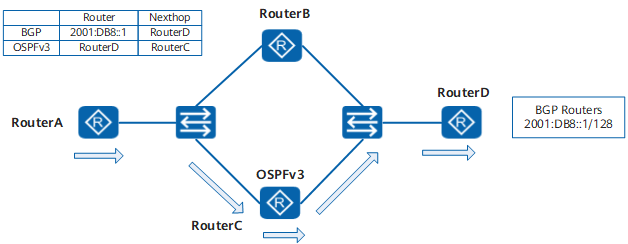
If a fault occurs on RouterC, traffic is redirected to RouterB after rerouting. Packets are lost when RouterC is restored to the normal status.
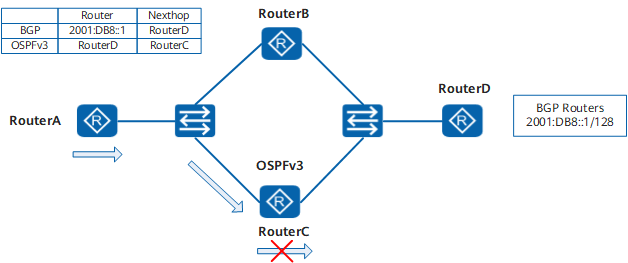
Because OSPFv3 convergence is quicker than BGP convergence, OSPFv3 convergence is complete when RouterC recovers. The next hop of the route from RouterA to RouterD is RouterC, which, however, does not know the route to RouterD since BGP convergence on RouterC is not complete.
Therefore, when the packets destined for RouterD are transmitted from RouterA to RouterC, they are discarded by RouterC because RouterC has no route to RouterD, as shown in Figure 2.
When a router enabled with association between OSPFv3 and BGP restarts, the router advertises a message in the local OSPFv3 area to instruct other routers not to use it as a transit router. At the same time, the router sets the largest weight value of 65535 in its LSAs to ensure that it is not used by other routers as the transit router. The BGP route, however, can still reach the router.