OSPFv3 GR
Graceful restart (GR) is a technology used to ensure normal traffic forwarding when a routing protocol restarts to ensure that key services are not affected in the process.
GR is one of the high availability (HA) technologies, which comprise a series of comprehensive technologies such as fault-tolerant redundancy, link protection, faulty node recovery, and traffic engineering. As a redundancy technology, GR is widely used to ensure uninterrupted forwarding of key data in active/standby switchover and system upgrade.
If GR is not enabled, the active/standby switchover occurring owing to various causes leads to transient interruption of data forwarding, and as a result, route flapping occurs on the whole network. Such route flapping and service interruption are unacceptable on a large-scale network, especially on a carrier network.
In GR mode, the forwarding plane continues to direct data forwarding once a restart occurs, and the actions no the control plane, such as reestablishment of neighbor relationships and route calculation, do not affect the forwarding plane. In this manner, service interruption caused by route flapping is prevented so that the network reliability is improved.
Basic Concepts
Grace LSA
- OSPFv3 supports GR by flooding grace LSAs on the link.
- Grace LSAs are used to inform the neighbor of the GR time, cause, and interface instance ID when GR starts and ends.
Router function
- A router can function as a GR restarter.
- A router can function as a GR helper.
GR implementation
- Planned-GR: This refers to the smooth restart of OSPFv3 through the reset ospfv3 graceful-restart command. In this mode, a grace LSA is sent to the neighbor before the restart.
Unplanned-GR: This refers to the active/standby switchover triggered by commands or the restart or active/standby switchover because of router faults.
Unlike planned-GR, no grace LSA is sent before the active/standby switchover in unplanned GR mode. Instead, the switchover is directly performed. When the standby board becomes Up, a grace LSA is sent and the GR process starts. The following procedure is the same as that of planned GR.
GR Process
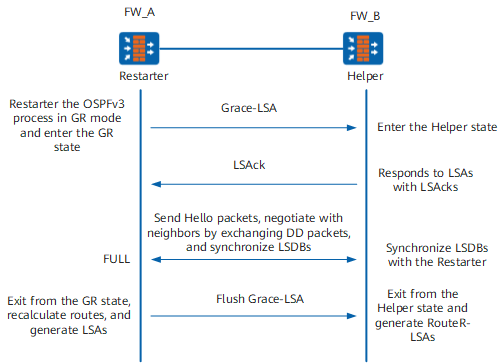
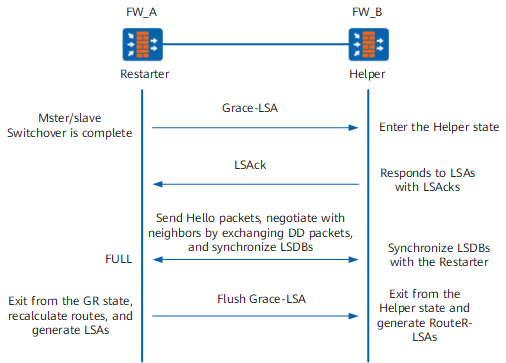
On the GR restarter:
In planned-GR mode, when OSPFv3 is restarted through commands, the GR restarter sends a grace LSA to all neighbors to inform them of the start of a GR process and the period and cause of this process.
In unplanned GR mode, when a restart occurs after active/standby switchover or owing to other causes other than commands, a grace LSA is sent to each neighbor immediately after the standby board is Up to inform the neighbors of the start of a GR process and the period and cause of the process.
- The GR restarter performs negotiation with neighbors again to set up new neighbor relationships.
When all the neighbor relationships between the GR restarter and the original neighbors enter the Full state:
- The GR restarter exits from the GR process and OSPFv3 recalculates routes.
- The GR restarter updates the routing table on the main control board and the FIBs on interface boards and deletes invalid routing entries.
- The GR restarter sends a grace LSA whose aging time is 3600 seconds to instruct the GR helper to exit from the GR process.
Now, the GR process is complete.
- If errors occur, the GR timer expires, or the neighbor relationship fails to enter the Full state during a GR process, the GR restarter exits from the process and OSPFv3 is restarted in non-GR mode. In this case, packets are lost.
On the GR helper:
- If a router is configured to support the GR process on its neighbor, the router enters the helper mode after receiving a grace LSA.
- The GR helper maintains its neighbor relationship with the GR restarter, and the status of the neighbor relationship does not change.
- If the GR helper continues to receive grace LSAs whose GR period is different from that on the GR helper, the GR helper updates its GR period.
- Being informed of the successful GR process through a grace LSA whose aging time is 3600 seconds from the GR restarter, the GR helper exits from the GR process.
- If errors occur during a GR process, the GR helper exits from the helper state and deletes invalid routes after route calculation.
Comparison Between the GR Mode and the Non-GR Mode
| Active/Standby Switchover in Non-GR Mode | Active/Standby Switchover in GR Mode |
|---|---|
|
|