Overview of SLB
SLB helps improve the service processing capability of enterprises and facilitate network operation, maintenance, and adjustment.
Ever-growing network traffic places servers under pressure. When a single server cannot satisfy network requirements, an enterprise usually replaces it with a higher-performance one or deploys more servers. The existing server will be idle and cause resource waste if it is replaced by a higher-performance one. A round of upgrade requiring significant efforts will be inevitable. The performance bottleneck, however, will remain. If the enterprise adopts the method of adding servers, it must tackle difficult issues, such as traffic distribution and server coordination. Also, the enterprise has to consider costs and site requirements, as well as future device upgrade and expansion. In such a situation, SLB emerges as an effective solution.
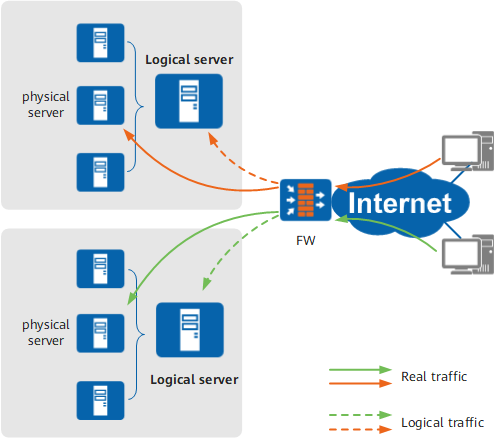
SLB employs multiple servers to process services arranged for one server, so as to increase service processing efficiency and capability. As shown in Figure 1, these servers form a server cluster and work as a logical server. The server for users to access is the logical one, while users do not know that services are processed by physical servers. The FW determines traffic distribution to servers. If a server is broken down, the FW does not distribute traffic to it. If the server cluster requires expansion, add servers to it. Users are unaware of such implementation, which is helpful for network operation, maintenance, and adjustment.
SLB ensures that traffic is balanced between servers to avoid the situation in which one server is fully loaded while another server is idle. The FW can employ traffic distribution methods based on service types to meet specific service requirements and raise service quality and efficiency.