HTTP Scheduling Policy
An HTTP scheduling policy determines how the FW distributes traffic to a server group. An HTTP scheduling policy and load balancing algorithm work together for better load balancing.
An HTTP scheduling policy is the core of SLB. The scheduling policy is defined based on the initial fields of HTTP, including URL, Referer, Host, and cookie. The HTTP scheduling policy is used to schedule a new real server group to process services. The load balancing algorithm is used to schedule real servers in the real server group to process services. For these fields, such as the URL field, real server groups in the HTTP and HTTPS server cluster have different processing capabilities and performance. Different URLs correspond to different real server groups. Therefore, a URL-specific HTTP scheduling policy is required to schedule a real server group.
An HTTP scheduling policy can be configured only when HTTP or HTTPS (SSL uninstallation is configured) is used to transmit packets.
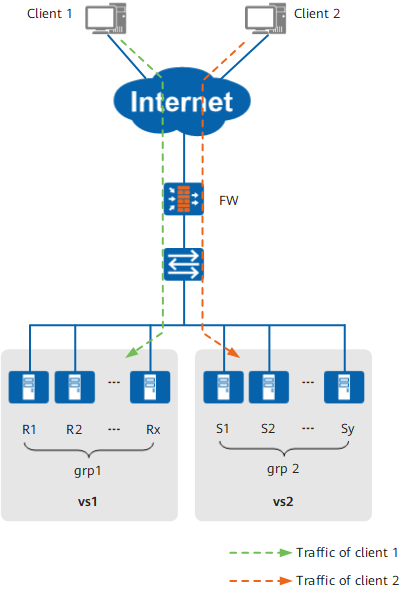
As shown in Figure 1, two HTTP server groups are deployed on the intranet. According to the HTTP scheduling policy, the FW distributes the service traffic of Client 1 to real server group 1 and the service traffic of Client 2 to real server group 2. The HTTP scheduling policy can be used to distribute client traffic to a suitable server group. If no HTTP scheduling policy is configured, the FW distributes traffic to servers in the configured real server group according to the load balancing algorithm.