Upgrading the VPN Client
This section describes how to load the VPN Client patch on the FW to upgrade vpn client components.
Uploading the vpn client to the FW
The SecoClient that supports this version has no longer evolved and cannot be downloaded from the Huawei Support website. The downloaded SecoClient can still be used. SecoClient configuration examples and common configuration problems are retained in the document. When users need to use the SSL VPN function through client access, see : VPN Client Download Description.
You can use FTP, TFTP, or SFTP to upload the vpn client to the FW.
Uploading the vpn client using FTP
The FW functions as an FTP client.
In such cases, the FTP server and FW can reside on different subnets, but they must be mutually reachable.
Run the FTP server program on the FTP host, place the vpn client to be downloaded in the corresponding FTP directory, and then run the specified command in the FW user view to download the vpn client to a directory on the FW. For details, see Configuring the FW as an FTP Client.
The FW functions as an FTP server.
In such cases, the FTP client and FW can reside on different subnets, but they must be mutually reachable.
Start the FTP server on the FW. For details, see Configuring the FW as an FTP Server. Use the FTP client to log in to the FW and upload the vpn client to the corresponding directory on the FW.
Uploading the vpn client using TFTP
The FW functions as a TFTP client to download the vpn client from the TFTP server. In such cases, the TFTP server and FW can reside on different subnets, but they must be mutually reachable.
Run the TFTP server program on the TFTP host and upload the vpn client to the corresponding TFTP directory. In the FW user view, run the specified command to download the vpn client to a directory on the FW. For details, see Configuring the FW as a TFTP Client.
Uploading the vpn client using SFTP
The FW functions as an SFTP client.
In such cases, the SFTP server and FW can reside on different subnets, but they must be mutually reachable.
Run the SFTP server program on the SFTP host, place the vpn client to be downloaded in the corresponding SFTP directory, and then run the specified command in the FW user view to download the vpn client to a directory on the FW. For details, see Configuring the FW as an SFTP Client.
The FW functions as an SFTP server.
In such cases, the SFTP client and FW can reside on different subnets, but they must be mutually reachable.
Start the SFTP server on the FW. For details, see Configuring the FW as an SFTP Server. Use the SFTP client to log in to the FW and upload the vpn client to the corresponding directory on the FW.

You are advised to use SFTP to upload the vpn client as SFTP is more secure than FTP and TFTP.
Upload the SecoClient software installation package to the FW
- run:
- Load VPN client software.
SecoClient for the Windows operating system (32 bit /64), the MAC operating system and the Linux operating system (32 bit /64) respectively, provided the corresponding software installation package. So the network administrator should load the corresponding software installation package according to the operating system type which the user actually uses.
vpn-client software { windows-32 | windows-64 | mac | linux-32 | linux-64 } filename filename
User obtains the software installation package
- The mobile user logs in to the SSL VPN gateway from a browser. For the login method, see Logging In to the SSL VPN Gateway.
- After the login succeeds, the virtual gateway page is displayed.

- Click Options on the upper right of the virtual gateway page. You can view the SecoClient software installation package in Download Network Extension Client.
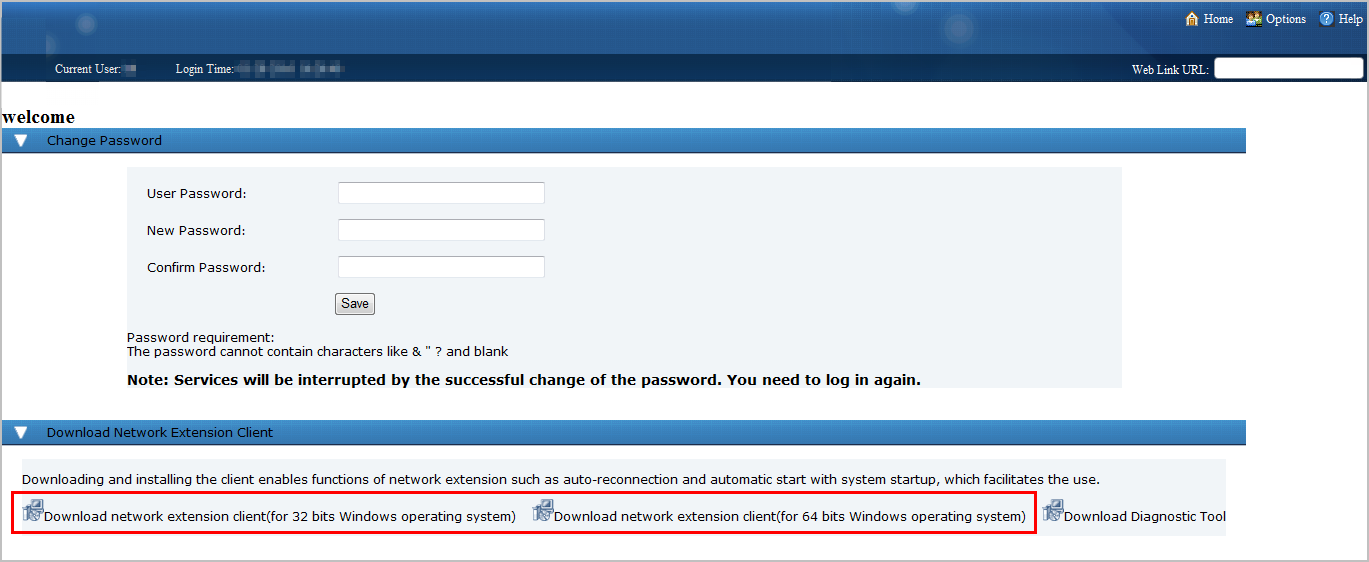
- Click the Download network extension client link to download the software installation package.
After obtaining the new SecoClient software installation package, the mobile user can uninstall the existing SecoClient software and then install the new SecoClient software.