CLI: Example for Configuring the SACG Interworking in Standalone Off-line Mode
In off-line mode, the SACG is directly connected to the core switch or router on the original network to implement the SACG Interworking, and the SACG Interworking can be deployed without affecting the original networking and requiring any network changes.
Networking Requirements
The Agile Controller server group is deployed on an enterprise network, and the FW is deployed in off-line mode at the egress of this network, as shown in Figure 1. The following requirements should be met:
- Different user roles can access different network resources (configured in Agile Controller servers).
- Once user roles change, available network resources should be updated instantly.
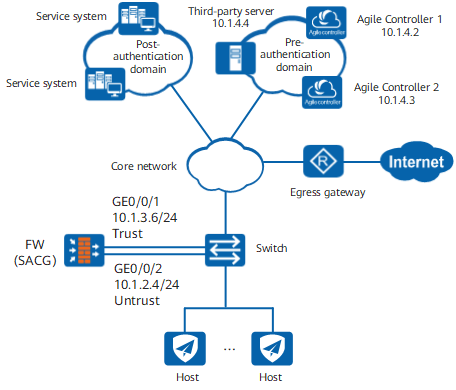
Data Planning
Item |
Data |
Description |
|
|---|---|---|---|
Agile Controller server 1 |
IP Address: 10.1.4.2 Port: 3288 Shared key: TSM_Security |
The port and shared key configured need to be identical with those configured on the Agile Controller server. |
|
Agile Controller server 2 |
IP Address: 10.1.4.3 Port: 3288 Shared key: TSM_Security |
The port and shared key configured need to be identical with those configured on the Agile Controller server. |
|
Third-party server |
IP address: 10.1.4.4 Protocol of packets supported by health check: HTTP Health check destination port: 80 Minimum number of active nodes for health check: 1 |
- |
|
Static route from the FW to the switch |
10.1.3.7 |
- |
|
Minimum number of active servers |
1 |
- |
|
Configuration Roadmap
The configuration roadmap is as follows:
- Disable the session status detection function.
- Configure the basic data of the FW
- Configure the default packet-filtering rule for the interzone.
- Add Agile Controller servers, and configure the authentication URL.
- Enable SACG and the status detection of the server.
- Apply the interworking policy to the interzone.
Procedure
- Disable the stateful detection function.

In off-line mode, the traffic only in one direction can pass through the SACG. Therefore, the status detection function must be disabled on the SACG. Functions that rely on stateful inspection are unavailable in off-line mode of the FW.
<FW> system-view
[FW] undo firewall session link-state check
- Configure interface IP addresses and security zones.
[FW] interface GigabitEthernet 0/0/1
[FW-GigabitEthernet0/0/1] ip address 10.1.3.6 255.255.255.0
[FW-GigabitEthernet0/0/1] quit
[FW] interface GigabitEthernet 0/0/2
[FW-GigabitEthernet 0/0/2] ip address 10.1.2.4 255.255.255.0
[FW-GigabitEthernet 0/0/2] quit
[FW] firewall zone trust
[FW-zone-Trust] add interface GigabitEthernet 0/0/1
[FW-zone-Trust] quit
[FW] firewall zone untrust
[FW-zone-Untrust] add interface GigabitEthernet 0/0/2
[FW-zone-Untrust] quit
- Configure security policies.
- Configure a security policy between the Local security zone and Trust security zone so that the Agile Controller can deliver rules to the FW.
- Configure a security policy between the Local security zone and Untrust security zone so that the FW can push web pages to users for authentication.
[FW] security-policy
[FW-security-policy] rule name sec_policy01
[FW-security-policy-sec_policy01] source-address 192.168.1.0 mask 255.255.255.0
[FW-security-policy-sec_policy01] source-zone trust
[FW-security-policy-sec_policy01] destination-zone local
[FW-security-policy-sec_policy01] action permit
[FW-security-policy-sec_policy01] quit
[FW-security-policy] rule name sec_policy02
[FW-security-policy-sec_policy02] source-zone local
[FW-security-policy-sec_policy02] destination-zone untrust
[FW-security-policy-sec_policy02] action permit
[FW-security-policy-sec_policy02] quit
[FW-security-policy] quit
- Configure interworking with the Agile Controller.
# Access the configuration view for interworking between the FW and Agile Controller and specify the default ACL number.
If ACLs 3099 to 3999 exist, delete them before specifying the default ACL number to avoid ACL conflicts on the FW.
[FW] right-manager server-group
[FW-rightm] default acl 3099
# Add a Agile Controller on the FW so that the FW can interwork with the Agile Controller. Two Agile Controllers are deployed. Therefore, run the server ip command twice to add the two Agile Controllers.

The values of port and shared-key in the server ip command must be the same as those on the Agile Controller. Otherwise, the SACG cannot be connected to the Agile Controller, and the SACG interworking cannot be used.
[FW-rightm] server ip 10.1.4.2 port 3288 shared-key TSM_Security
[FW-rightm] server ip 10.1.4.3 port 3288 shared-key TSM_Security
# Configure non-agent web authentication. When a terminal on which the SACG agent is not installed attempts to access a network, the FW pushes a web authentication page to the terminal.
[FW-rightm] right-manager authentication url http://10.1.4.2:8080/webauth
[FW-rightm] right-manager authentication url http://10.1.4.3:8080/webauth
- If a terminal uses an agent to access the web server in the post-authentication domain, the FW cannot push a web page to the terminal.
- The web page push configuration applies to all terminal hosts and does not require, ACL matching.
- If multiple web pages are configured, the FW selects one of them to push.
# Enable a server to connect the FW to the Agile Controller to send an interworking request. After the connection succeeds, the FW can receive a role and rules of the role from the Agile Controller.
[FW-rightm] right-manager server-group enable# Configure the emergency channel function and set the minimum number of Agile Controllers that are connected to the FW to 1. Therefore, if the FW successfully connects to one or more Agile Controllers, SM detection will be restored. If the FW cannot connect to any Agile Controller due to the failure of Agile Controllers, the emergency channel is enabled so that all terminals are allowed to access controlled networks.
[FW-rightm] right-manager status-detect enable
[FW-rightm] right-manager server-group active-minimun 1
[FW-rightm] quit
# Apply the interworking policy to the inbound direction (Untrust-to-Trust) of the Trust and Untrust zones so that hosts can communicate with the pre-authentication domain and permit rules of the emergency channel can be delivered to the Trust-Untrust interzone.
The interworking policy is applied to the inbound direction because the source (host) is in the Untrust zone, the destination (pre-authentication domain) is in the Trust zone, and the security level of the Untrust zone is lower than that of the Trust zone.
[FW] firewall interzone trust untrust
[FW-interzone-trust-untrust] apply packet-filter right-manager inbound
[FW-interzone-trust-untrust] quit
# Configure a static route through which the inspected traffic is injected from the FW to the switch. The next hop of the route is the IP address of the switch interface connected to the GigabitEthernet0/0/1. That is because GigabitEthernet0/0/1 is the interface that connects the FW to the post-authentication domain and the FW needs to forward traffic to the post-authentication domain through this interface after security inspection is compete.
[FW] ip route-static 0.0.0.0 0.0.0.0 10.1.3.7 - Optional: Configure health check for third-party
servers.
In SACG scenarios, some account and password information is stored on the Agile Controller, and some account and password information is stored on the third-party authentication server. When a user enters the account and password on the client to initiate an identity authentication request, if the account and password are stored on the Agile Controller, the Agile Controller authenticates the user. If the account and password are stored on the third-party authentication server, the AC-Campus will send the account information to the third-party server for authentication. The third-party server sends the authentication result to the AC-Campus. The AC-Campus authorizes the user based on the authentication result.
In the scenario where user authentication is done on the Agile Controller, if the Agile Controller detects that the number of active Agile Controller is smaller than the configured smallest value, the emergency channel is enabled. The Agile Controller cannot detect whether the third-party authentication server is active. If an exception occurs, user authentication cannot be done on the third-party authentication server. In this case, the FW acting as the SACG needs to check the health of the third-party authentication server. If the health status of the third-party authentication server is Down, the FW enables the emergency channel, ensuring service continuity. After the fault is rectified, the emergency channel is automatically disabled, and the original permission control for the user is restored.
In this example, the IP address of the third-party server in the pre-authentication domain is 10.1.4.4; the port number is 80; the detection protocol is HTTP; and detection packets are sent through GigabitEthernet 0/0/1.
[FW] healthcheck enable
[FW] healthcheck name hchk1
[FW-healthcheck-hchk1] least active-linknumber 1
[FW-healthcheck-hchk1] destination 10.1.4.4 interface GigabitEthernet 0/0/1 protocol http destination-port 80
[FW-healthcheck-hchk1] quit
[FW] right-manager server-group
[FW-rightm] healthcheck hchk1
- Optional: Add the upstream and downstream interfaces GigabitEthernet 0/0/2 and GigabitEthernet 0/0/1 to the same link group.
After the upstream and downstream interfaces are added to the same link group, redirection or policy-based routing configured on the switch does not take effect and the traffic is not sent to the FW if either the upstream or downstream link fails.
[FW] interface GigabitEthernet 0/0/2
[FW-GigabitEthernet 0/0/2] link-group 1
[FW-GigabitEthernet 0/0/2] quit
[FW] interface GigabitEthernet 0/0/1
[FW-GigabitEthernet0/0/1] link-group 1
[FW-GigabitEthernet0/0/1] quit
# Return to the user view and save the configurations.
[FW] quit
<FW> save
- Configure the Agile Controller.
On the Service Manager, add the connection parameters of the SACG, configure the pre-authentication domain and post-authentication domain, and create user information. For details, see the Agile Controller documentation.
Verification
Run the display right-manager server-group command on the FW to view the Agile Controller status.
<FW> display right-manager server-group
Server group state  :  Enable
Server number :       2
Server ip address       Port      State      Master
10.1.4.2             3288      active          Y
10.1.4.3             3288      active          N
The value of State is active, indicating that the Agile Controllers are successfully connected and the configuration succeeds.
After the Agile Controller whose IP address is 10.1.4.2 is shut down, Master of the Agile Controller at 10.1.4.3 is Y, indicating that the connection state is normal and interworking with the Agile Controller can function properly when one or more Agile Controllers are connected to the FW.
Configuration Scripts
#
sysname FW
#
security-policy
 rule name sec_policy01
 source-address 192.168.1.0 mask 255.255.255.0
 source-zone trust
 destination-zone local
 action permit

 rule name sec_policy02
 source-zone local
 destination-zone untrust
 action permit
#
undo firewall session link-state check
#
interface GigabitEthernet0/0/1
 link-group 1
 ip address 10.1.3.6 255.255.255.0
#
interface GigabitEthernet0/0/2
 link-group 1
 ip address 10.1.2.4 255.255.255.0
#
firewall zone local
 set priority 100
#
firewall zone trust
 set priority 85
 add interface GigabitEthernet0/0/1
#
firewall zone untrust
 set priority 5
 add interface GigabitEthernet0/0/2
#
firewall zone dmz
 set priority 50
#
ip route-static 0.0.0.0 0.0.0.0 10.1.3.7
#
healthcheck enable
healthcheck name hchk1
least active-linknumber 1
destination 10.1.4.4 interface GigabitEthernet 0/0/1 protocol http destination-port 80
#
right-manager server-group
 healthcheck hchk1
 default acl 3099
 server ip 10.1.4.2 port 3288 shared-key %$%$!g8A4;cd.T(7d@Bdhw#~iI@7%$%$
 server ip 10.1.4.3 port 3288 shared-key %$%$!g8A4;cd.T(7d@Bdhw#~iI@7%$%$
 right-manager server-group enable
 right-manager status-detect enable
 right-manager server-group active-minimun 1
 right-manager authentication url http://10.1.4.2:8080/webauth
 right-manager authentication url http://10.1.4.3:8080/webauth
#
firewall interzone trust untrust
 apply packet-filter right-manager inbound
#
return