Web: Example for Enabling Remote Users to Use Internet Explorer to Access Enterprise Intranet Through Network Extension (User Name + Password Authentication)
Networking Requirements
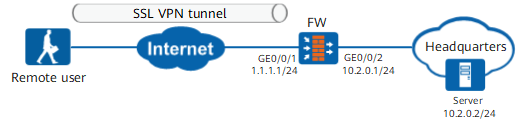
As shown in Figure 1, local authentication of the FW is used to authenticate employees in each department. Authenticated users can access the enterprise intranet.
The enterprise has the following requirement: Remote users in a group (group1) can obtain an intranet IP address when they are on the move and can access resources in the enterprise as if they were on a LAN. To enhance security, local authentication through user name and password is required.
Procedure
- Configure interfaces.
- Choose .
- Click
 of GigabitEthernet 0/0/1 and set parameters as follows.
Zone
untrust
IPv4
IP address
1.1.1.1/24
- Click OK.
- Repeat the preceding steps to set the parameters for GigabitEthernet 0/0/2.
Zone
trust
IPv4
IP address
10.2.0.1/24
- Configure user objects and authentication.
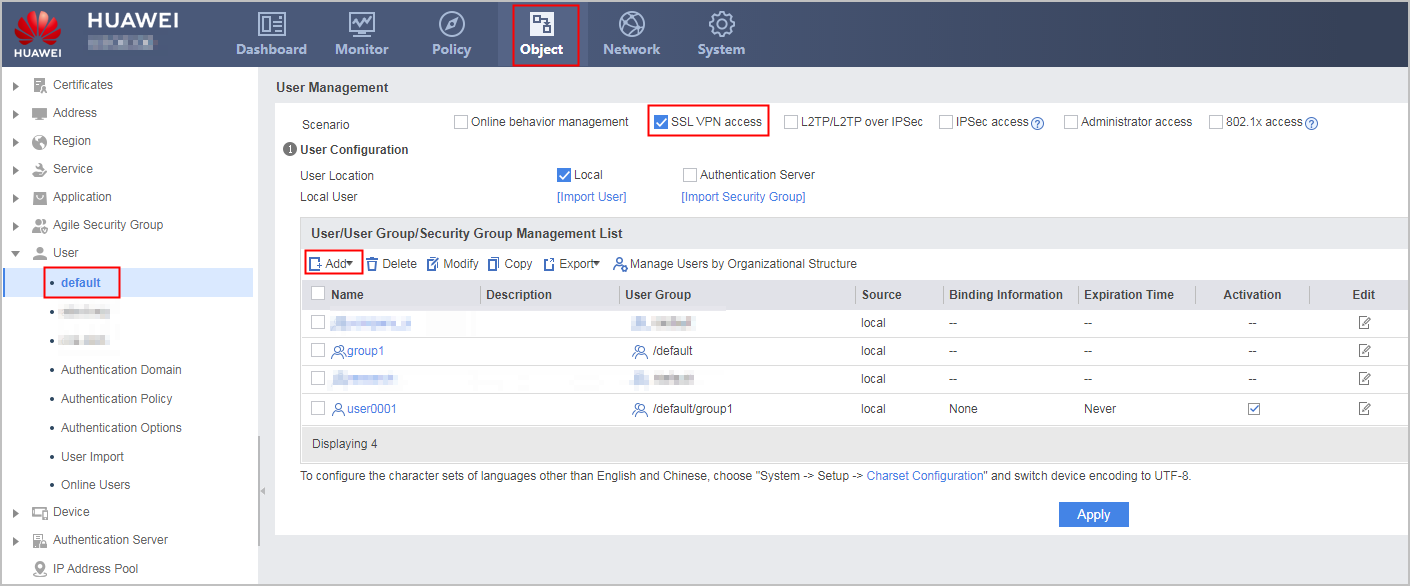
- Choose and set parameters as follows:
User user0001 belongs to user group /default/group1. Authentication Type is local authentication, and Password is Password@123. Before creating user user0001, you need to create group /default/group1 so that you have a group to reference when creating a user.
- Click Apply.
- Choose and set parameters as follows:
- Configure the SSL VPN gateway.
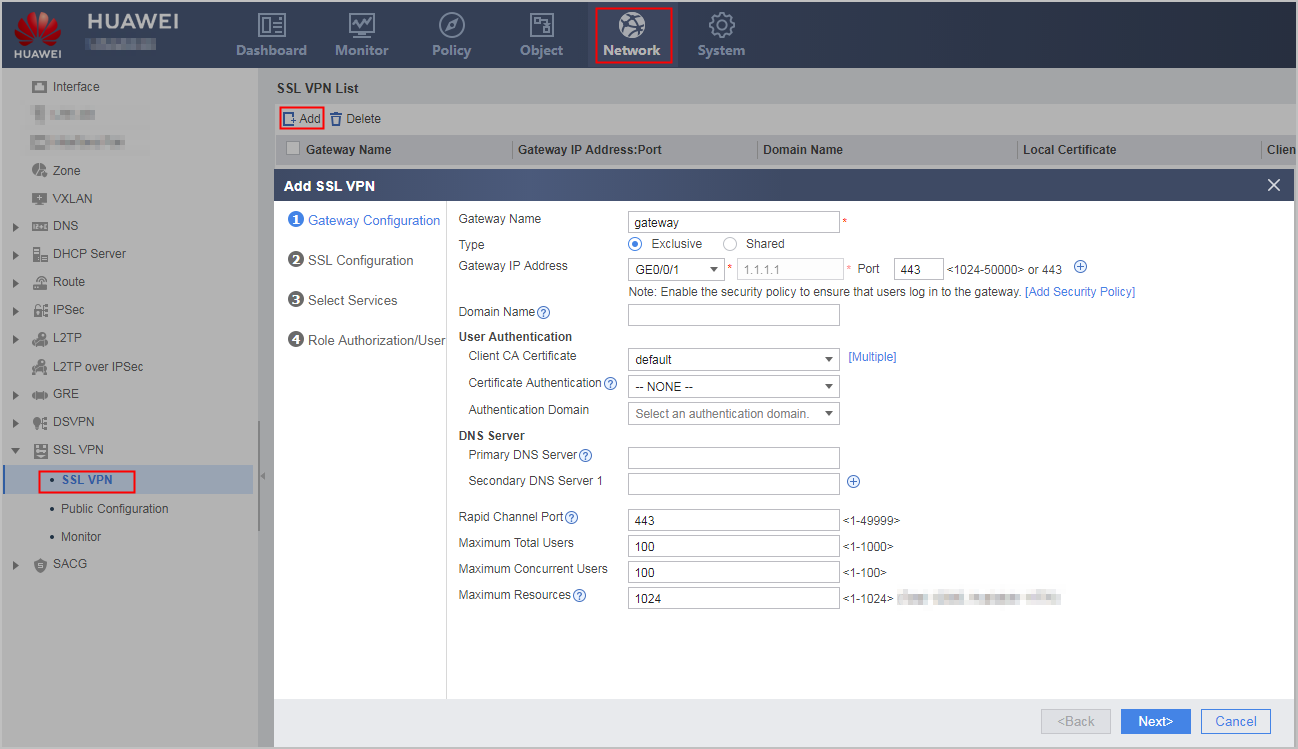
- Choose .
- Click Add and set parameters as follows.
- Click Next.
- Configure the SSL version, cipher suite, session timeout duration, and session lifecycle. You can use the default values and click Next.
- Select Network Extension and click Next.
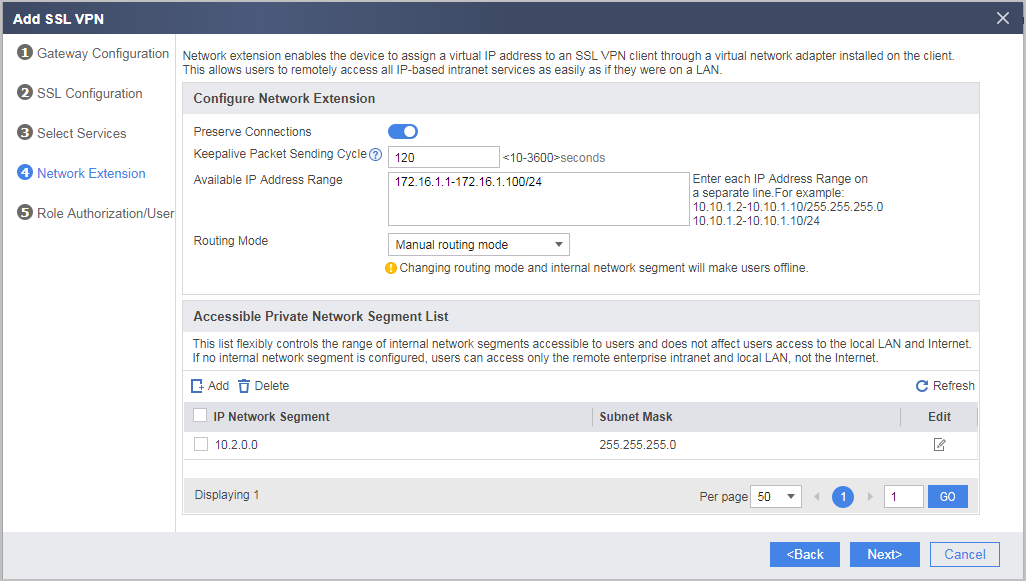
- Configure the network extension function.
- Configure SSL VPN role authorization/users.
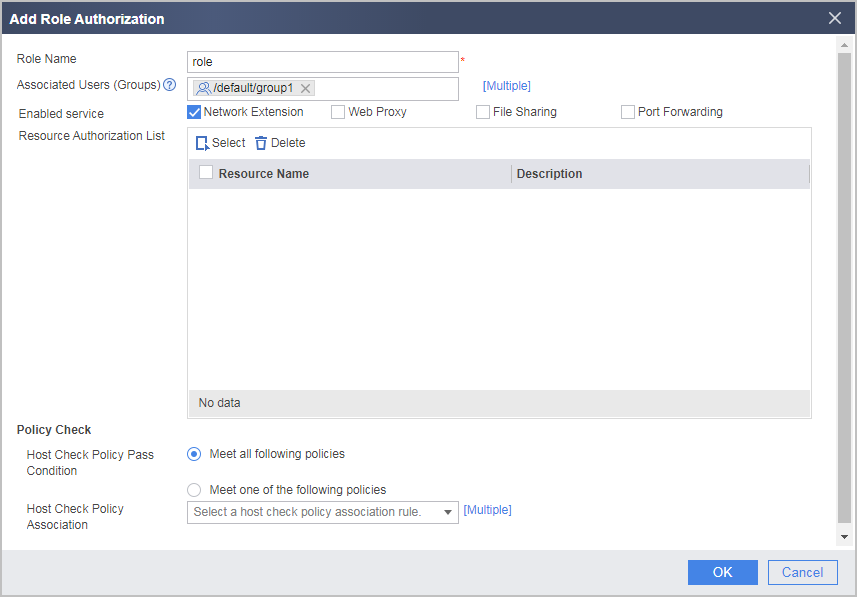
- Click Add in List of Authorized Roles and set the role authorization parameters as follows. After the configuration is completed, click OK.
- Return to the Role Authorization/User configuration page, and click Finish.
- Click Add in List of Authorized Roles and set the role authorization parameters as follows. After the configuration is completed, click OK.
- Configure security policies.
- Configure an Internet-to-FW security policy to allow employees on the move to access the SSL VPN gateway.
- Choose .
- Click Add to configure security policy policy01 and set parameters as follows:
Name
policy01
Source Zone
untrust
Destination Zone
local
Destination Address/Region
1.1.1.1/24
Service
https
NOTE:If the HTTPS port number is changed, use the new port number when creating the security policy.
Action
Permit
- Click OK.
- Configure a FW-to-intranet security policy to allow employees on the move to access resources at the Headquarters.
- Choose .
- Click Add to configure security policy policy02 and set parameters as follows:
Name
policy02
Source Zone
untrust
Destination Zone
trust
Source Address/Region
172.16.1.0/24
Destination Address/Region
10.2.0.0/24
Action
Permit
- Click OK.
- Configure an Internet-to-FW security policy to allow employees on the move to access the SSL VPN gateway.
Verifying the Configuration
- Enter https://1.1.1.1:443 in the address bar of Internet Explorer to access the SSL VPN login page.
Install the control as prompted upon the first login.
- In the login window, enter the user name and password, and then click Login.
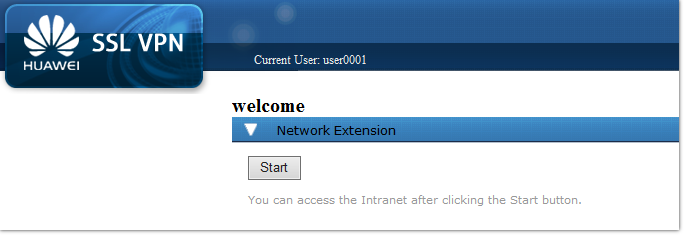
After the login is successful, click Start under Network Extension. Then you can access the corresponding servers on the enterprise intranet.
Configuration Script
#
aaa
 authentication-scheme default
 authorization-scheme default
 domain default
  service-type ssl-vpn
  internet-access mode password
  reference user current-domain
#
interface GigabitEthernet 0/0/1
 ip address 1.1.1.1 255.255.255.0
#
interface GigabitEthernet 0/0/2
 ip address 10.2.0.1 255.255.255.0
#
firewall zone trust
 set priority 85
 add interface GigabitEthernet 0/0/2
#
firewall zone untrust
 set priority 5
 add interface GigabitEthernet 0/0/1
#
v-gateway gateway interface GigabitEthernet 0/0/1 private
v-gateway gateway authentication-domain default
#
#****BEGIN***gateway**1****#
v-gateway gateway
 basic
  ssl version tlsv11 tlsv12
  ssl timeout 5
  ssl lifecycle 1440
  ssl ciphersuit custom aes256-sha aes128-sha
 service
  network-extension enable
  network-extension keep-alive enable
  network-extension keep-alive interval 120
  network-extension netpool 172.16.1.1 172.16.1.100 255.255.255.0
  netpool 172.16.1.1 default
  network-extension mode manual
  network-extension manual-route 10.2.0.0 255.255.255.0
 security
  policy-default-action permit vt-src-ip
  certification cert-anonymous cert-field user-filter subject cn group-filter subject cn
  certification cert-anonymous filter-policy permit-all
  certification cert-challenge cert-field user-filter subject cn
  certification user-cert-filter key-usage any
  public-user enable
  public-user default-login-number 500
 hostchecker
 cachecleaner
 vpndb
  group /default
  group /default/group1
 role
 role default
  role default condition all
 role role
  role role condition all
  role role network-extension enable
#****END****#
#
security-policy
 rule name policy01
  source-zone untrust
  destination-zone local
  destination-address 1.1.1.0 mask 255.255.255.0
  service https
  action permit
 rule name policy02
  source-zone untrust
  destination-zone trust
  source-address 172.16.1.0 mask 255.255.255.0
  destination-address 10.2.0.0 mask 255.255.255.0
  action permit
#
# The following configurations are saved in the database and are not displayed in the configuration file.  user-manage user user0001 domain default
 password %$%$j@p.U.0bwNQv9nE#tf]G-+"v%$%$
  parent-group /default/group1
 v-gateway gateway
  role
 role role group /default/group1