CLI: Configuring Intranet Users of Virtual Systems to Access the Internet Through the WAN Interface of the Public System (Performing NAT in the Public System)
Networking Requirements
As shown in Figure 1, the device is deployed as a Layer 3 gateway between the intranet and Internet. The intranet is divided into two independent LANs: network A and network B, which are isolated from each other and have no overlapping IP addresses.
User hosts on networks A and B access the Internet through the shared WAN interface GE0/0/1 of the public system. On network A, only some user hosts can access the Internet. On network B, all user hosts can access the Internet. In addition, source NAT is performed in the public system to translate the source IP addresses of the packets from the intranet to the Internet into the public IP address of the device. In this way, the intranet IP addresses are hidden.
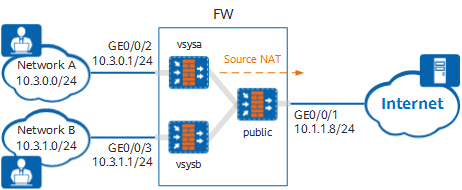
Item |
Data |
Description |
|---|---|---|
public |
WAN interface: GE0/0/1 WAN interface IP address: 10.1.1.8/24 Security zone to which the WAN interface belongs: untrust LAN interface: virtual system Virtual-if0 of the public system Security zone to which the LAN interface belongs: trust IP address of the carrier access gateway: 10.1.1.1/24 |
In this example, intranet user hosts attached to virtual systems can access the Internet only through the public system. As the private IP addresses of networks A and B attached to the virtual systems do not overlap, you can configure a source NAT policy in the public system. |
vsysa |
Virtual system name: vsysa WAN interface: virtual interface Virtual-if1 of vsysa Security zone to which the WAN interface belongs: untrust LAN interface: GE0/0/2 LAN interface IP address: 10.3.0.1/24 Private IP address range: 10.3.0.0/24 Security zone to which the LAN interface belongs: trust IP addresses allowed to access the Internet: 10.3.0.2 to 10.3.0.10 |
- |
vsysb |
Virtual system name: vsysb WAN interface: virtual interface Virtual-if2 of vsysb Security zone to which the WAN interface belongs: untrust LAN interface: GE0/0/3 LAN interface IP address: 10.3.1.1/24 Private IP address range: 10.3.1.0/24 Security zone to which the LAN interface belongs: trust |
- |
Resource class |
Resource class name: r1 Guaranteed number of IPv4 sessions: 10000 Maximum number of IPv4 sessions: 50000 Guaranteed number of policies: 300 Guaranteed total bandwidth: 20 Mbit/s |
In this example, networks A and B have similar service resource usage requirements and therefore are allocated the same virtual system resources. |
Configuration Roadmap
- Enable the virtual system function.
- Configure resource classes based on service requirements, create virtual systems vsysa and vsysb in the public system, and allocate resources to the virtual systems.
- Configure interfaces for the public system, vsysa, and vsysb, and add the interfaces to security zones.
- Configure routes in the public system, vsysa, and vsysb to divert traffic from networks A and B to the Internet.
- Configure security policies in the public system, vsysa, and vsysb based on service requirements to permit traffic from user hosts on networks A and B to the Internet.
- Configure a source NAT policy in the public system to translate the source IP addresses of the packets from the intranet to the Internet into the IP address of the WAN interface of the public system.
Procedure
- Enable the virtual system function.
<FW> system-view
[FW] vsys enable
- Configure a resource class.
[FW] resource-class r1
[FW-resource-class-r1] resource-item-limit session reserved-number 10000 maximum 50000
[FW-resource-class-r1] resource-item-limit policy reserved-number 300
[FW-resource-class-r1] resource-item-limit bandwidth 20 entire
[FW-resource-class-r1] quit
- Create virtual systems and allocate resources to them.
# Create virtual system vsysa and allocate resources to it.
[FW] vsys name vsysa
[FW-vsys-vsysa] assign resource-class r1
[FW-vsys-vsysa] assign interface GigabitEthernet 0/0/2
[FW-vsys-vsysa] quit
# Create virtual system vsysb and allocate resources to it.
[FW] vsys name vsysb
[FW-vsys-vsysb] assign resource-class r1
[FW-vsys-vsysb] assign interface GigabitEthernet 0/0/3
[FW-vsys-vsysb] quit
- Configure interfaces for the public system and add the interfaces to security zones.
[FW] interface GigabitEthernet 0/0/1
[FW-GigabitEthernet0/0/1] ip address 10.1.1.8 24
[FW-GigabitEthernet0/0/1] quit
[FW] interface Virtual-if 0
[FW-Virtual-if0] ip address 172.16.0.1 24
[FW-Virtual-if0] quit
[FW] firewall zone trust
[FW-zone-trust] add interface Virtual-if 0
[FW-zone-trust] quit
[FW] firewall zone untrust
[FW-zone-untrust] add interface GigabitEthernet 0/0/1
[FW-zone-untrust] quit
- Configure a route from the public system to the Internet to divert traffic from networks A and B to the Internet. 10.1.1.1 is the next-hop address of the route from the public system to the Internet.
[FW] ip route-static 0.0.0.0 0.0.0.0 10.1.1.1 - Configure a security policy in the public system to permit traffic from user hosts on networks A and B to the Internet.
[FW] security-policy
[FW-policy-security] rule name trust_to_untrust
[FW-policy-security-rule-trust_to_untrust] source-zone trust
[FW-policy-security-rule-trust_to_untrust] destination-zone untrust
[FW-policy-security-rule-trust_to_untrust] source-address 10.3.0.0 24
[FW-policy-security-rule-trust_to_untrust] source-address 10.3.1.0 24
[FW-policy-security-rule-trust_to_untrust] action permit
[FW-policy-security-rule-trust_to_untrust] quit
[FW-policy-security] quit
- Configure a source NAT policy to translate the source IP addresses of the packets from networks A and B to the Internet into the IP address of the independent WAN interface GE0/0/1 of the public system.
[FW] nat-policy
[FW-policy-nat] rule name nat1
[FW-policy-nat-rule-nat1] source-zone trust
[FW-policy-nat-rule-nat1] egress-interface GigabitEthernet 0/0/1
[FW-policy-nat-rule-nat1] source-address 10.3.0.0 24
[FW-policy-nat-rule-nat1] source-address 10.3.1.0 24
[FW-policy-nat-rule-nat1] action source-nat easy-ip
[FW-policy-nat-rule-nat1] quit
[FW-policy-nat] quit
- Switch to the system view of vsysa.
[FW] switch vsys vsysa
<FW-vsysa> system-view
- Configure interfaces for vsysa and add the interfaces to security zones.
[FW-vsysa] interface GigabitEthernet 0/0/2
[FW-vsysa-GigabitEthernet0/0/2] ip address 10.3.0.1 24
[FW-vsysa-GigabitEthernet0/0/2] quit
[FW-vsysa] interface Virtual-if 1
[FW-vsysa-Virtual-if1] ip address 172.16.1.1 24
[FW-vsysa-Virtual-if1] quit
[FW-vsysa] firewall zone trust
[FW-vsysa-zone-trust] add interface GigabitEthernet 0/0/2
[FW-vsysa-zone-trust] quit
[FW-vsysa] firewall zone untrust
[FW-vsysa-zone-untrust] add interface Virtual-if 1
[FW-vsysa-zone-untrust] quit
- Configure routes in vsysa.
# Configure a route from the public system to vsysa to divert the traffic for network A to access the Internet to the public system.
[FW-vsysa] ip route-static 0.0.0.0 0.0.0.0 public# Configure a route from vsysa to network A. 10.3.0.254 is the next-hop address of the route from vsysa to network A.
[FW-vsysa] ip route-static 10.3.0.0 255.255.255.0 10.3.0.254 - Configure security policies in vsysa.
# Allow user hosts in the IP address range of 10.3.0.2 to 10.3.0.10 on network A to access the Internet.
[FW-vsysa] security-policy
[FW-vsysa-policy-security] rule name to_internet_allow
[FW-vsysa-policy-security-rule-to_internet_allow] source-zone trust
[FW-vsysa-policy-security-rule-to_internet_allow] destination-zone untrust
[FW-vsysa-policy-security-rule-to_internet_allow] source-address range 10.3.0.2 10.3.0.10
[FW-vsysa-policy-security-rule-to_internet_allow] action permit
[FW-vsysa-policy-security-rule-to_internet_allow] quit
# Forbid user hosts that are not in the IP address range of 10.3.0.2 to 10.3.0.10 on network A from accessing the Internet.
[FW-vsysa-policy-security] rule name to_internet_block
[FW-vsysa-policy-security-rule-to_internet_block] source-zone trust
[FW-vsysa-policy-security-rule-to_internet_block] destination-zone untrust
[FW-vsysa-policy-security-rule-to_internet_block] action deny
[FW-vsysa-policy-security-rule-to_internet_block] quit
# Forbid communication between network A and network B. Because a route has been configured in the public system to divert the return traffic to vsysb, vsysa and vsysb can communicate with each other across the public system. To isolate vsysa and vsysb from each other, you must configure this security policy in vsysa.
[FW-vsysa-policy-security] rule name to_vsysb_block
[FW-vsysa-policy-security-rule-to_vsysb_block] source-zone trust
[FW-vsysa-policy-security-rule-to_vsysb_block] destination-zone untrust
[FW-vsysa-policy-security-rule-to_vsysb_block] destination-address 10.3.1.0 24
[FW-vsysa-policy-security-rule-to_vsysb_block] action deny
[FW-vsysa-policy-security-rule-to_vsysb_block] quit
[FW-vsysa-policy-security] quit
- Switch to the system view of vsysb.
[FW-vsysa] quit
<FW-vsysa> quit
[FW] switch vsys vsysb
<FW-vsysb> system-view
- Configure interfaces for vsysb and add the interfaces to security zones.
[FW-vsysb] interface GigabitEthernet 0/0/3
[FW-vsysb-GigabitEthernet0/0/3] ip address 10.3.1.1 24
[FW-vsysb-GigabitEthernet0/0/3] quit
[FW-vsysb] interface Virtual-if 2
[FW-vsysb-Virtual-if2] ip address 172.16.2.1 24
[FW-vsysb-Virtual-if2] quit
[FW-vsysb] firewall zone trust
[FW-vsysb-zone-trust] add interface GigabitEthernet 0/0/3
[FW-vsysb-zone-trust] quit
[FW-vsysb] firewall zone untrust
[FW-vsysb-zone-untrust] add interface Virtual-if 2
[FW-vsysb-zone-untrust] quit
- Configure routes in vsysb.
# Configure a route from the public system to vsysb to divert the traffic for network B to access the Internet to the public system.
[FW-vsysb] ip route-static 0.0.0.0 0.0.0.0 public# Configure a route from vsysb to network B. 10.3.1.254 is the next-hop address of the route from vsysb to network B.
[FW-vsysb] ip route-static 10.3.1.0 255.255.255.0 10.3.1.254 - Configure security policies in vsysb.
# Allow user hosts on network B to access the Internet.
[FW-vsysb] security-policy
[FW-vsysb-policy-security] rule name to_internet_allow
[FW-vsysb-policy-security-rule-to_internet_allow] source-zone trust
[FW-vsysb-policy-security-rule-to_internet_allow] destination-zone untrust
[FW-vsysb-policy-security-rule-to_internet_allow] source-address 10.3.1.0 24
[FW-vsysb-policy-security-rule-to_internet_allow] action permit
[FW-vsysb-policy-security-rule-to_internet_allow] quit
# Forbid communication between network A and network B. Because a route has been configured in the public system to divert the return traffic to vsysa, vsysa and vsysb can communicate with each other across the public system. To isolate vsysa and vsysb from each other, you must configure this security policy in vsysb.
[FW-vsysb-policy-security] rule name to_vsysa_block
[FW-vsysb-policy-security-rule-to_vsysa_block] source-zone trust
[FW-vsysb-policy-security-rule-to_vsysa_block] destination-zone untrust
[FW-vsysb-policy-security-rule-to_vsysa_block] destination-address 10.3.0.0 24
[FW-vsysb-policy-security-rule-to_vsysa_block] action deny
[FW-vsysb-policy-security-rule-to_vsysa_block] quit
[FW-vsysb-policy-security] quit
Verifying the Configuration
- User hosts in the IP address range of 10.3.0.2 to 10.3.0.10 on network A can access the Internet, but other user hosts cannot.
- All user hosts on network B can access the Internet.
Configuration Scripts
- Public system
# sysname FW # vsys enable # resource-class r1 resource-item-limit session reserved-number 10000 maximum 50000 resource-item-limit policy reserved-number 300 resource-item-limit bandwidth 20 entire # vsys name vsysa 1 assign resource-class r1 assign interface GigabitEthernet0/0/2 # vsys name vsysb 2 assign resource-class r1 assign interface GigabitEthernet0/0/3 # interface GigabitEthernet0/0/1 undo shutdown ip address 10.1.1.8 24 # interface Virtual-if 0 ip address 172.16.0.1 255.255.255.0 # firewall zone trust set priority 85 add interface Virtual-if0 # firewall zone untrust set priority 5 add interface GigabitEthernet0/0/1 # ip route-static 0.0.0.0 0.0.0.0 10.1.1.1 # security-policy rule name trust_to_untrust source-zone trust destination-zone untrust source-address 10.3.0.0 mask 255.255.255.0 source-address 10.3.1.0 mask 255.255.255.0 action permit # nat-policy rule name nat1 source-zone trust egress-interface GigabitEthernet0/0/1 source-address 10.3.0.0 mask 255.255.255.0 source-address 10.3.1.0 mask 255.255.255.0 action source-nat easy-ip # return - Virtual system (vsysa)
#
interface GigabitEthernet0/0/2
 ip address 10.3.0.1 255.255.255.0
#
interface Virtual-if 1
 ip address 172.16.1.1 255.255.255.0
#
firewall zone trust
 set priority 85
 add interface GigabitEthernet0/0/2
#
firewall zone untrust
 set priority 5
 add interface Virtual-if1
#
 ip route-static 0.0.0.0 0.0.0.0 public
 ip route-static 10.3.0.0 255.255.255.0 10.3.0.254
#
security-policy
 rule name to_internet_allow
  source-zone trust
  destination-zone untrust
  source-address range 10.3.0.2 10.3.0.10
  action permit
 rule name to_internet_block
  source-zone trust
  destination-zone untrust
  action deny
 rule name to_vsysb_block
  source-zone trust
  destination-zone untrust
  destination-address 10.3.1.0 mask 255.255.255.0
  action deny
#
return
- Virtual system (vsysb)
#
interface GigabitEthernet0/0/3
 ip address 10.3.1.1 255.255.255.0
#
interface Virtual-if 2
 ip address 172.16.2.1 255.255.255.0
#
firewall zone trust
 set priority 85
 add interface GigabitEthernet0/0/3
#
firewall zone untrust
 set priority 5
 add interface Virtual-if2
#
 ip route-static 0.0.0.0 0.0.0.0 public
 ip route-static 10.3.1.0 255.255.255.0 10.3.1.254
#
security-policy
 rule name to_internet_allow
  source-zone trust
  destination-zone untrust
  source-address 10.3.1.0 mask 255.255.255.0
  action permit
 rule name to_vsysa_block
  source-zone trust
  destination-zone untrust
  destination-address 10.3.0.0 mask 255.255.255.0
  action deny
#
return