Dual Hubs in Load Balancing Mode
A single Hub can connect to a certain number of Spokes due to its performance limitation. When there are many Spokes on a network, you can deploy two or more Hubs to improve the processing capability of the headquarters.
In Figure 1, Hub1 and Hub2 are deployed in the headquarters. Not all Spokes can register with one Hub because there are many Spokes, so some Spokes are registered with Hub1 and Hub2 to implement load balancing.
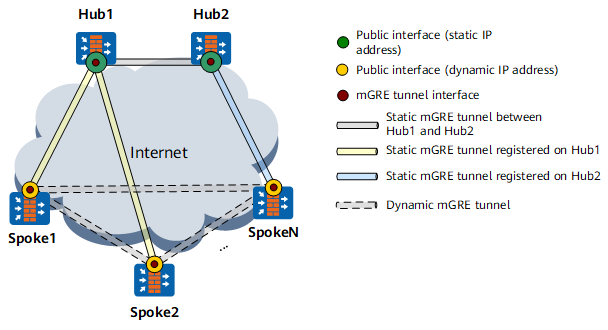
The principle of direct communication between Spokes connected to the same Hub is similar to Principles. Static mGRE tunnels need to be set up between Hubs to allow Spokes connected to different Hubs to directly communicate with each other.
The direct communication process between Spokes connected to different Hubs is as follows:
- A source Spoke1 sends an NHRP Resolution Request packet to Hub1 to request the public network address of destination SpokeN.
- Hub1 forwards the NHRP Resolution Request packet to Hub2 over the static mGRE tunnel between Hub1 and Hub2.
- Hub2 forwards the NHRP Resolution Request packet to the destination SpokeN.
- The destination SpokeN obtains the public network address of the source Spoke1 from the NHRP Resolution Request packet and sends an NHRP Resolution Reply packet to the source Spoke1.
- The source Spoke1 obtains the public network address of the destination SpokeN from the NHRP Resolution Reply packet and establishes a dynamic mGRE tunnel with the destination SpokeN.
After the dynamic mGRE tunnel is set up, Spokes connected to the two Hubs can directly communicate with each other.