CLI: Example for Configuring L2TP VPN (RADIUS Authentication) in the Client-Initiated Scenario
This section provides an example for configuring L2TP VPN in the client-initiated scenario. In the client-initiated scenario, the LNS works with the RADIUS server to perform identity authentication for mobile users.
Networking Requirements
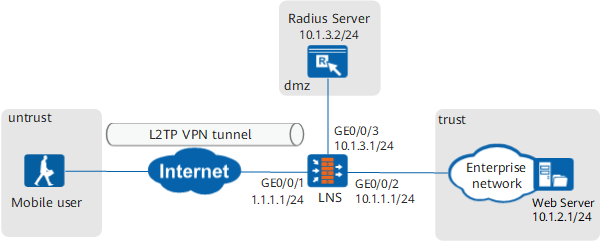
Data Planning
Item |
Data |
|
|---|---|---|
LNS |
Interface |
Interface ID: GigabitEthernet 0/0/1 IP address: 1.1.1.1/24 Security zone: Untrust Interface ID: GigabitEthernet 0/0/2 IP address: 10.1.1.1/24 Security zone: Trust Interface ID: GigabitEthernet 0/0/3 IP address: 10.1.3.1/24 Security zone: DMZ |
L2TP configuration |
User name: user0001 Password: Password123 Peer tunnel name: client Tunnel authentication password: Hello123 Address pool: 172.16.1.2 to 172.16.1.100 NOTE:
If the intranet server IP address and address pool addresses are on different network segments, configure a route on the intranet server to an address in the address pool. |
|
Parameters for interconnection with the RADIUS server |
RADIUS server address: 10.1.3.2/24 Shard key: Radius123 |
|
Mobile user |
User name: user0001 Password: Password123 Tunnel name: client Tunnel authentication password: Hello123 |
|
Procedure
- Configure the LNS.
- Configure L2TP access users and an authentication policy on the LNS.
- Set parameters for interconnecting with the RADIUS server.
- Configure RADIUS authentication for user identity authentication.
- Configure an address pool.
If the actual address pool addresses and headquarters addresses reside on the same network segment, you must enable the proxy ARP function on the LNS interface connecting to the headquarters to ensure that the LNS can respond to the ARP requests from the servers at the headquarters.
[LNS] ip pool pool
[LNS-ip-pool-pool] section 1 172.16.1.2 172.16.1.100
[LNS-ip-pool-pool] quit
- Configure the service scheme used by access users.
- Configure the authentication domain and reference the RADIUS server template and authentication scheme.
- Configure L2TP access users and an authentication policy on the LNS.
- Configure a RADIUS server. For how to configure a RADIUS server, see the documents of the RADIUS server.
- Configure the SecoClient at the mobile user side.
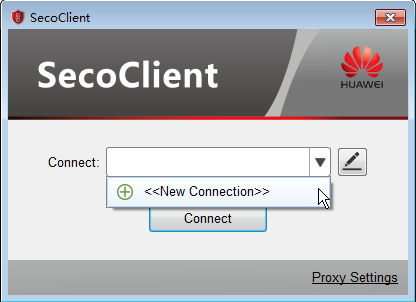
- Open the SecoClient and access the home page.
Select New Connection from the Connect drop-down list.
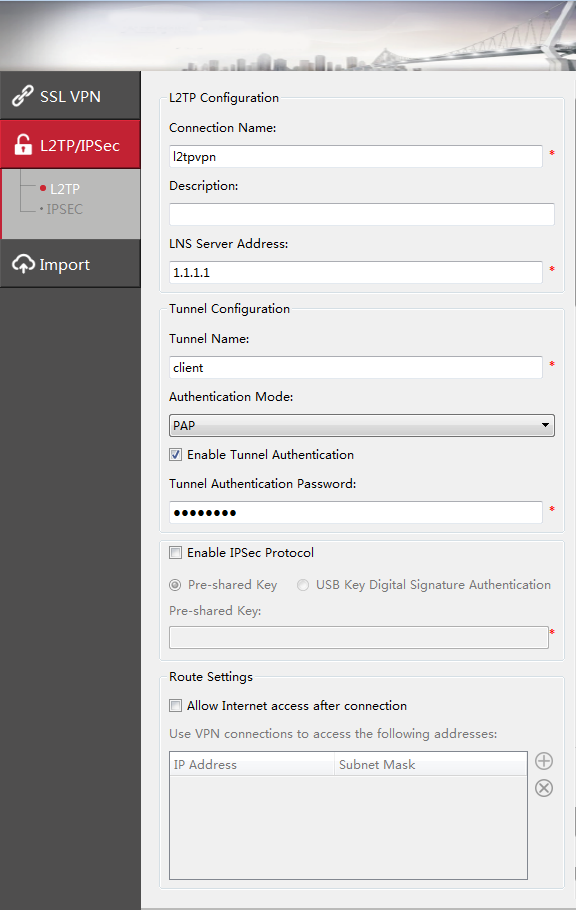
- Set L2TP VPN connection parameters.
In the New Connection navigation tree, select L2TP/IPSec. Set connection parameters and click OK.
The tunnel authentication password is Hello123.
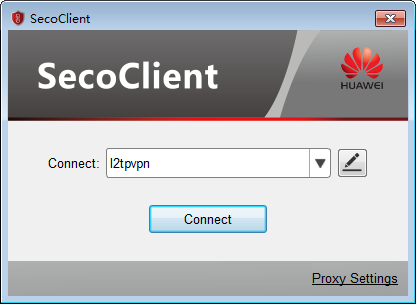
- Log in to the L2TP VPN gateway.
- Select the created L2TP VPN connection from the Connect drop-down list and click Connect.
- On the login page, enter the user name and password.
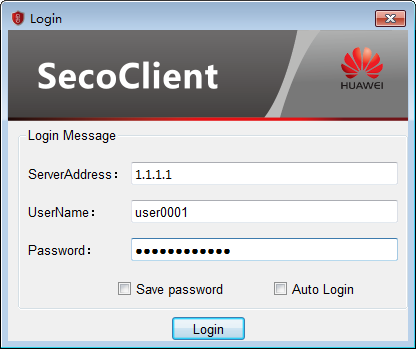
- Click Login to initiate a VPN connection request.
A message on a VPN access success will be displayed on the web UI.
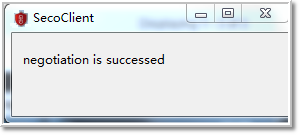
After the connection is established, mobile users can access intranet resources as intranet users.
- Select the created L2TP VPN connection from the Connect drop-down list and click Connect.
- Open the SecoClient and access the home page.

Verification
- Mobile users can properly access intranet servers of the headquarters.
Check the L2TP tunnel establishment on the LNS.
- Run the display l2tp tunnel command to check L2TP tunnel information. According to the command output, an L2TP tunnel is established successfully.
[LNS] display l2tp tunnel
L2TP::Total Tunnel: 1

 LocalTID RemoteTID RemoteAddress    Port   Sessions RemoteName  VpnInstance
 ------------------------------------------------------------------------------
 2        1         2.2.2.2          61535   1         client
 ------------------------------------------------------------------------------
  Total 1, 1 printed
Run the display l2tp session command to check L2TP session information. According to the command output, an L2TP session is established successfully.
[LNS] display l2tp session
L2TP::Total Session: 1

  LocalSID  RemoteSID  LocalTID   RemoteTID  UserID  UserName    VpnInstance
 ------------------------------------------------------------------------------
  119       32         2           1         9689    user0001
 ------------------------------------------------------------------------------
  Total 1, 1 printed
- Run the display l2tp tunnel command to check L2TP tunnel information. According to the command output, an L2TP tunnel is established successfully.
Configuration Scripts
#
sysname LNS
#
 l2tp enable
 l2tp domain suffix-separator @
#
radius-server template radius_lns
 radius-server shared-key cipher %^%#Dx7bUW}UNDmwB'U[]_M>CpAHG[Cu:R:B{b#o(n3~%^%#
 radius-server authentication 10.1.3.2 1645
#
ip pool pool
 section 0 172.16.1.2 172.16.1.100
#
aaa
 authentication-scheme scheme_radius
  authentication-mode radius
 service-scheme l2tp
  ip-pool pool
 domain default
  authentication-scheme scheme_radius
  radius-server radius_lns
  service-type l2tp
#
l2tp-group 1
 tunnel password cipher %$%$)Ev%*KV_Q1qLG11R-<t%nU]<%$%$
 allow l2tp virtual-template 1 remote client domain default
#
interface Virtual-Template 1
 ppp authentication-mode pap
 remote service-scheme l2tp
 ip address 172.16.1.1 255.255.255.0
#
interface GigabitEthernet 0/0/1
 undo shutdown
 ip address 1.1.1.1 255.255.255.0
#
interface GigabitEthernet 0/0/2
 undo shutdown
 ip address 10.1.1.1 255.255.255.0
#
interface GigabitEthernet 0/0/3
 undo shutdown
 ip address 10.1.3.1 255.255.255.0
#
firewall zone trust
 set priority 85
 add interface GigabitEthernet 0/0/2
#
firewall zone untrust
 set priority 5
 add interface GigabitEthernet 0/0/1
#
firewall zone dmz
 set priority 50
 add interface GigabitEthernet 0/0/3
 add interface Virtual-Template1
#
ip route-static 0.0.0.0 0.0.0.0 1.1.1.2
#
security-policy
 rule name service_td
  source-zone trust
  destination-zone dmz
  source-address 10.1.2.0 mask 255.255.255.0
  destination-address 172.16.1.0 mask 255.255.255.0
  action permit
 rule name service_dt
  source-zone dmz
  destination-zone trust
  source-address 172.16.1.0 mask 255.255.255.0
  destination-address 10.1.2.0 mask 255.255.255.0
  action permit
 rule name l2tp_ul
  source-zone untrust
  destination-zone local
  destination-address 1.1.1.0 mask 255.255.255.0
  action permit
 rule name radius_ld
  source-zone local
  destination-zone dmz
  source-address 10.1.3.0 mask 255.255.255.0
  action permit