Typical DHCP Networking
DHCP adopts the client/server model in which a client dynamically applies to a server for an IP address, subnet mask, default gateway, and other network configurations. The server then replies with configuration information according to configured policies.
Figure 1 shows the typical DHCP networking.
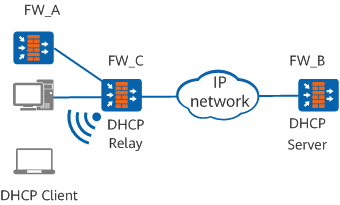

DHCP broadcast messages cannot be fragmented.
DHCP client:
Exchanges messages with a DHCP server to obtain an IP address and other configuration parameters.
On the FW, an interface can function as a DHCP client to dynamically obtain configuration parameters such as an IP address from a DHCP server, facilitating configuration and centralized management.
DHCP server:
Processes address allocation, address lease extending, and address releasing requests from a DHCP client or a DHCP relay agent, and allocates IP addresses and other network configuration parameters to DHCP clients.
(Optional) DHCP relay agent:
Forwards DHCP messages between a DHCP server and DHCP clients to help the DHCP server dynamically allocate network parameters to DHCP clients.
When a DHCP client broadcasts DHCP Discovery messages with the destination IP address 255.255.255.255, only the DHCP server on the same network segment as the DHCP client can receive the messages. If a DHCP server is on a different network segment from the DHCP client, a DHCP relay agent must be deployed to forward DHCP Discovery messages to the DHCP server. The DHCP relay agent modifies the format of a DHCP Discovery or Offer message to generate a new DHCP message and then forwards it, which is different from traditional IP packet forwarding.
A DHCP relay agent is required in scenarios where terminals on an enterprise network are located on multiple network segments and need to obtain network parameters through DHCP. This enables the terminals to communicate with one DHCP server, saving server resources and facilitating unified management.